Criminal Profile Template
- Criminal Profile Layout Template
- Blank Criminal Profile Template
- Criminal Profile Template Google Docs
- Fbi Criminal Profile Template
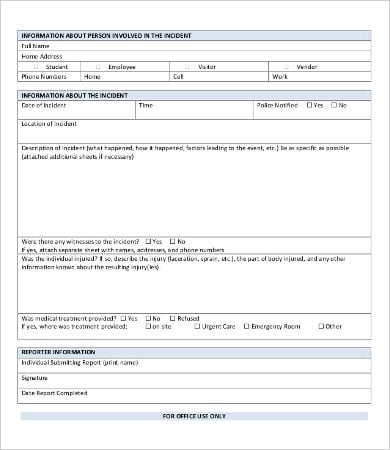
A criminal profile can be created from any blood stains and is done by blood stain analysts who undertake extensive research on the component. For instance, the Deoxyribonucleic acid of the criminal is able to be identified if their blood was left at the crime scene. This sample of crime report template has a detailed description of all the details related to the crime scene and the offender. It begins with the time, date and place of the incident and has further provision for describing the ethnicity, residence, driver license number and other details of the offender.
What is a criminal profiler?
A criminal profiler is part of the investigative team and uses specialized techniques and training to identify suspects. Criminal profilers, also known as criminal investigative analysts, compile and compare data from similar crimes and offenders to create a profile of a suspect. They form logical hypotheses based on witness reports, victim testimony and crime scene evidence. Criminal profilers often lead investigations as they study the nature of a crime, analyze the clues left behind and interview witnesses to inform their conclusions.
Key duties, roles and responsibilities of a criminal profiler
In order to develop psychological profiles of a suspect based on evidence, profilers must have extensive investigatory knowledge and the ability to review and analyze evidence. Profilers work closely with law enforcement agencies, visit crime scenes and perform extensive analysis to identify patterns or consistencies in criminal behavior. Profilers are required to continue training to stay current with laws and regulations as well as learning new or modern investigative techniques and tools.
The primary duties of a criminal profiler include:
- Identify behavior patterns
- Understand investigative strategy, crime analysis and interviewing techniques
- Perform personality assessments and geographic profiling
- Study human behavior and characteristics
- Conduct research, analyze data and form conclusions
- Advise police officers and investigators
- Read and write reports
- Engage in ongoing training
- Adhere to laws and regulations
- Provide expert courtroom testimony
Related: How to Write a Job Description
Education and experience requirements for criminal profilers
Typical educational and experience requirements for criminal profilers include:
- Bachelor’s in psychology, criminal justice, forensics and behavioral science, at minimum
- Master’s or doctorate degree in criminal justice
- Attendance in a law enforcement academy
- Extensive experience in law enforcement and investigative techniques
- Additional industry certifications
- Strong verbal and written communication skills
- Intuition and analytical skills
- No prior felony records
While a bachelor’s degree is the minimum requirement, some positions may require an advanced degree or certification. For example, profilers applying to work for the FBI typically need seven to 15 years of job experience, must meet eligibility requirements and complete academy training before advancing to become profilers.
The FBI academy involves training in several areas, including:
- Physical fitness
- Intelligence and evidence collection
- Interrogation and negotiation tactics
- Firearm training
- Defensive driving
Related: Behavioral Interview Questions to Ask Candidates
Job outlook for criminal profilers
Criminal profilers work in a competitive and specialized field within law enforcement. Although job growth specifically for criminal profilers isn’t measured, the U.S. Bureau of Labor Statistics reports a 14% growth outlook for those in forensic sciences between 2018 and 2028. Job growth for investigators is at 5%, which suggests increasing demands for specialized fields such as criminal profiling.
Criminal profiler FAQs
Here are common questions about criminal profilers and what they do.
How is criminal profiling done?
Criminal profiling is done by identifying similar behaviors and patterns in certain criminals through the examination of evidence and the application of psychology techniques. Profiling uses historical data and behavior to assign characteristics in order to make predictions about a criminal. Using profile analysis data as well as evidence and witness testimony, profilers can help law enforcement pinpoint a suspect.
Profilers typically map criminal:
- Behavior patterns
- Personality traits
- Physical appearance
Where does a criminal profiler work?
Profilers may work for local law enforcement agencies and forensic experts. Most criminal profilers are employed by the FBI in the Behavioral Analysis Unit (BAU) and work in the National Center for the Analysis of Violent Crime (NCAVC) in Quantico, VA. Some profilers may also work for the Bureau of Tobacco and Firearms to identify arsonists and bombers.
What skills does a criminal profiler need?
Criminal profilers are highly skilled in several areas of investigation and analysis. Typical skills criminal profilers possess include:
- Attention to detail: Profilers know that every piece of evidence provides clues to build a profile of a suspect. Details are necessary when determining a suspect’s appearance, age, dress, mannerism and methods. They are also able to notice details that other people might miss, such as social cues and patterns that may not be as obvious to other people.
- Analytical skills: In order to form a profile of someone they have never met, profilers are able to recognize clues, specific traits or behavioral patterns that others may overlook. They are also able to analyze complex data while staying attentive to small details.
- Communication skills: Profilers work with many different law enforcement agencies and people. Profilers are skilled at effectively explaining how they arrived at their theories or conclusions.
- Physical stamina: While the specific requirements may vary from agency to agency, criminal profilers need to demonstrate and maintain a high level of physical fitness and stamina.
When did criminal profiling begin?
In 1972, the FBI created the Behavioral Science Unit (BSU) that was used mostly for work on serial crimes. Work centered around the examination of a criminal’s behavior as it relates to:
- Suspect pre-crime tendencies, such as what circumstances led to the crime or why the criminal chose that victim or location
- Manner of crimerelating to how the crime was carried out or which weapons were used and why
- Post-crime behavior, such as whether the criminal is trying to interject into the investigation, influence the media or revisit a crime scene
Techniques have become more sophisticated over time, and profilers use old and new techniques to track not only serial crime but also:
- Arson
- Kidnappings
- Terrorism
- Extortion
- Cybercrimes
Criminal Profiling Part 3
In the second part of this criminal profiling series we established that the primary aim of criminal profiling is to reveal the behavioral make-up of an unknown offender. In part 3, we are going to take a look at how proponents of profiling believe this is possible, and to do this we need to examine the concept of signature behavior.
Signature Behavior
Turvey provides a very useful two part definition of signature behavior.
Signature Behaviors:
Signature behaviors are those acts committed by an offender that are not necessary to complete the offense. Their convergence can be used to suggest an offender’s psychological or emotional needs (signature aspect). They are best understood as a reflection of the underlying personality, lifestyle, and developmental experiences of an offender.
Signature Aspects:
The emotional or psychological themes or needs that an offender satisfies when they commit offense behaviors.
Retired homicide detective Robert Keppel, renowned for investigating serial killers Ted Bundy and Gary Ridgway has written widely on criminal profiling and signature behavior analysis. In 2002 I was fortunate enough to hear him speak at a forensic science conference in Atlanta.
Entitled 'A signature analysis of the eight Whitechapel murders attributed to Jack the Ripper in 1888' Robert Keppel's presentation sought to explain the processes involved in linking murder cases through Modus Operandi and signature.
The reason I want to include it here is that I remember thinking at the time, and still do, that it provides an excellent way of showing how the MO and signature differ in terms of what they tell you about a particular crime. The following information is taken from Keppel’s abstract in the conference proceedings.
Jack The Ripper's Modus Operandi
He attacked white female prostitutes in their 40’s in a cluster of victims within a short distance of each other. The first four victims Mary Nichols, Annie Chapman, Elizabeth Stride and Catherine Eddowes were killed and found outdoors in the Whitechapel area; then he changed his MO by killing and leaving the fifth victim Mary Kelly, indoors.
By choosing to murder Kelly indoors, the killer demonstrated that he was an experienced night time cat burglar and stalker, as he attacked all his victims in the early morning hours when dawn was approaching.
Jack The Ripper's Signature
Remember this relates to what the Ripper did over and above what was necessary to commit the crime – it transcends the MO.
Each victim was posed in a sexually degrading position, intentionally left that way so the discovery of the bodies would startle the people who found them. They were not concealed or hidden away, but placed in locations where they would be easily discovered.
The placing of the victims on their back, grotesquely laid out with their throats cut and viscera exposed or missing, reflect the cruel reality of the killer, his total mastery over their bodies. The pleasure for the killer was demonstrating each victims vulnerability.
Incidentally Keppel does not believe that all the murders attributed to Jack the ripper where in fact carried out by him. He claims that in the case of three of his alleged victims there were fundamental differences in the signature of the crimes. However, there is no doubt that like his fellow writers on the topic Keppel firmly believes that signature behavior represents a real and intrinsic part of the offender’s personality.
'Hidden among the evidence, often gleaned from the marks and wounds on the victim’s body…these signatures are the only ways the killer truly expresses himself.'
(Keppel & Burns)
MO Vs. Signature

I’m sure you’ve all watched a film or TV series where a detective at a crime scene asks 'What’s the MO?'. MO stands for Modus Operandi and it literally means way of working and it’s what an offender does in order to carry out a crime.
For example, a burglar who always uses a glass cutter to gain access to a house is demonstrating an aspect of his or her MO or way of working. From an investigative point of view analysis of the offenders MO can be used to link cases at crime scenes, however, a major stumbling block is that an offenders MO (way of working) can change.
Former FBI criminal profiling expert John Douglas provides a clear and concise account of the investigative limitations of MO analysis.
When attempting to link cases, the M.O. has great significance. A critical step in crime scene analysis is the resulting correlation that connects cases due to similarities in M.O. But, what causes an offender to use a certain M.O.? What circumstances shape the M.O.? Is the M.O. static or dynamic?
Unfortunately, investigators make a serious error by placing too much significance on the M.O. when linking crimes. For example, a novice burglar shatters a locked basement window to gain access to a house. Fearing that the sound of a window breaking will attract attention, he rushes in his search for valuables. Later, during subsequent crimes, he brings tools to force open locks, which will minimize the noise. This allows him more time to commit the crimes and to obtain a more profitable haul.
As shown, the burglar refined his breaking-and-entering techniques to lower the risk of apprehension and to increase profits. This demonstrates that the M.O. is a learned behavior that is dynamic and malleable. Developed over time, the M.O. continuously evolves as offenders gain experience and confidence. Incarceration usually impacts on the future M.O’s of offenders, especially career criminals. Offenders refine their M.O’s as they learn from the mistakes that lead to their arrests.
I’ve highlighted key words above to emphasize the idea that criminal profiling is driven in part by the notion that you can never guarantee that a serial offender will exhibit a consistent MO. Hence the reason for the criminal profiling school of thought that you must analyze behavior that transcends the MO, i.e. innate, static and rigid behaviour that fundamentally remains the same over time.
This behavior relates to the things offenders are psychologically compelled to do over and above what it takes to commit the crime, and in the world of criminal profiling it is known as signature behavior.
Criminal Profile Layout Template
Putting Theory Into Practice
Assuming you accept the notion that profiling makes it possible to elicit a behavioral signature, what do you have to do to pick up on these psychological clues? And what do you do with this information once you have it?
Blank Criminal Profile Template
The best way to think about these questions is to look at the traditional criminal profiling methodology employed by the FBI. So what do they do?
Put simply the investigative team work through a series of systematic stages.
Stage 1: Profiling Inputs:
The first stage involves collecting as much crime related information as possible, autopsy reports, photographs of the crime scene and deceased, essentially anything that is likely to indicate what happened, how it happened and why it happened.
Stage 2: Decision Processing:
Criminal Profile Template Google Docs
Armed with the information from stage one the next step involves determining whether the crime in question can be located within a number of behavioral classifications. The FBI developed their own manual of classifications and it functions along the same lines as the system used to classify mental illness. In essence you have a checklist of signs and symptoms and if these are sufficiently present within a particular case the offender will be assigned that classification.
This is why you see multi dimensional descriptions of profiled offenders e.g. organized, power assertive serial rapist. This stage will also generate a number of more general classifications e.g. the murder type (mass, spree, serial etc); the primary motive (sexual, financial, emotional etc).
Stage 3: Crime Assessment:
The principal aim of stage three is to piece together the chain of events before, during and after the commission of a crime. Essentially the profiler wants to reconstruct the crime from the perspective of both the victim and the offender.
Fbi Criminal Profile Template
Stage 4: The Criminal Profile:
Having assessed and consolidated the information from the previous stages the profiler is now in a position to hypothesize about the type of person who committed the crime. The preliminary description will usually include details relating to the suspects sex, age, race, occupational skills, IQ, social interests, mental health status and family background.
Stage 5: Investigative Use:
There are two main ways in which profiling is used to assist an investigation. Firstly a detailed written report is made available to the investigating team so that they can concentrate their efforts on suspects who appear to match the profile. The aim is to generate a reliable profile of the person who’s committed the unsolved crime so that the subsequent investigative effort is much more focused. Now this may seem like an obvious point but arguably the greatest strength of profiling is that it has the potential to minimize information overload.
So what exactly do I mean by information overload? Well to give you two examples, in the US the search for the 'green river killer' (Gary Ridgway) in Seattle generated 18,000 possible suspects and a single TV appeal generated 3500 tip-offs. Even more staggering was the Yorkshire Ripper inquiry in the UK which generated 268,000 named suspects and involved the police conducting 27,000 house visits.
The second way in which criminal profiling is traditionally employed within an investigation follows the arrest of a prime suspect, when the psychological aspects of the profile can be used to help develop and inform appropriate interviewing strategies.
You can read the previous articles in the criminal profiling series via the following links.
Criminal Profiling Part 1 (First Use)
Criminal Profiling Part 2 (FBI Legacy)
Read My Profiling Book
Book Description
Based on the criminal profiling content covered on this website, Criminal Profiling: An Introductory Guide is designed to let you dive straight into this fascinating topic. The guide provides clear and concise information on such things as the origins of criminal profiling, FBI profiling methodology and limitations; and whether becoming a profiler is a realistic career path.
If you are interested in criminal profiling and would like to learn more, Criminal Profiling: An Introductory Guide is the perfect place to start.
 Criminal Profiling: An Introductory Guide
UK Visitors Click Here
Go From Criminal Profiling Part 3 Back To The Home Page